
The Great Indonesian Language Paradox
Why Standard Textbooks Are Sabotaging Your Fluency
In the vast landscape of language education, the Indonesian language is frequently marketed to English speakers as an incredibly easy target. Educational blogs, language software developers, and travel guides constantly boast about its simplicity. They emphasize the lack of complex verb conjugations, the total absence of grammatical gender, and the highly convenient use of the familiar Latin alphabet. They sell a captivating dream of rapid fluency and effortless conversations.
However, as a researcher, I must firmly challenge this narrative.
This marketing strategy borders on linguistic deception. It completely ignores the most formidable and overwhelming wall a learner will hit the moment they step off the airplane.
The true challenge of the Indonesian language is not found in its core grammar. The absolute biggest hurdle for foreigners is the phenomenon of diglossia.
Diglossia is the massive, almost incomprehensible divide between the formal standard language taught in classrooms and the vibrant, chaotic street language used by millions of locals in their daily lives. If you diligently study Indonesian from a standard textbook, you are effectively mastering a language that nobody actually speaks to their friends.
The Historical Roots of a Divided Language
To truly understand this severe linguistic division, we must look deeply into the political and social history of the nation.
Bahasa Indonesia, the formal standard language, is essentially an artificial construct born out of political necessity rather than organic social evolution. In the year 1928, during the height of the Indonesian nationalist movement against colonial rule, political activists drafted the Youth Pledge. This pivotal document declared a single unifying language for the entire archipelago. Rather than choosing Javanese, which was the language of the largest and most powerful ethnic majority, the founding figures selected a standardized and elevated version of Malay.
This decision was a brilliant strategic and political move. It prevented any single ethnic group from asserting total cultural dominance and successfully united thousands of disparate islands under one common banner. However, this top-down approach meant that formal Indonesian, which is known locally as Bahasa Baku, was birthed primarily in official government documents, elite literature, and national news broadcasts. It was not born organically in the living rooms, casual street markets, or village squares of the nation.
Today, Bahasa Baku remains the strict language of the government, academia, the legal system, and polite journalism. Yet, the moment Indonesians leave their offices and talk to their family members, intimate friends, or local vendors, they completely abandon Bahasa Baku. They instantly switch to Bahasa Gaul, a highly fluid and ever-changing colloquial language.
Bahasa Gaul is heavily influenced by the hundreds of distinct regional languages spread across the vast country, especially regional heavyweights like Javanese, Sundanese, and Betawi. It features entirely different vocabulary sets, heavily abbreviated words, and a completely unique conversational rhythm.
Therefore, undertaking the task of learning Indonesian is not simply learning one cohesive language. It absolutely requires learning two parallel but distinct modes of communication.
The Psychological and Cognitive Toll on Learners
The psychological and cognitive toll this massive divide takes on a dedicated learner is immense and frequently underestimated by educators.
Imagine spending an entire year diligently studying formal Indonesian in a sterile classroom setting. You meticulously memorize your extensive vocabulary lists. You perfect your careful pronunciation of formal pronouns. You feel entirely confident in your ability to communicate. Then, you finally travel to a major city like Jakarta or Surabaya. You walk into a bustling local coffee shop and confidently attempt to order a simple drink. The barista responds enthusiastically, and you realize with absolute horror that you understand nothing at all.
This devastating scenario is the exact reality for the vast majority of foreigners. The formal language you mastered so carefully is virtually useless for building basic personal connections or navigating casual environments.
The challenge lies in the total transformation of the language structure.
In formal Indonesian, the designated word for the pronoun "I" is "saya" and the corresponding word for "you" is "Anda". In casual Jakarta slang, these formal terms are entirely discarded and replaced by "gue" and "lu". The formal, dictionary-approved word for "no" is "tidak", but on the street, it morphs into "nggak" or "enggak".
Furthermore, verbs consistently lose their formal prefixes and suffixes, entirely changing how sentences sound. The entire structure of the spoken sentence becomes severely compressed, dropping words that formal grammar rules deem strictly necessary. Learners face a harsh realization that their extensive textbook foundation is completely inadequate for fundamental social survival. This creates an intense and deeply frustrating barrier to cultural integration.
A student can literally read a national newspaper editorial with perfect comprehension, but that same student will be completely lost listening to two teenagers chatting casually on a public bus.
This jarring phenomenon causes many enthusiastic learners to simply quit out of pure frustration. They feel they have been tricked by the educational system. They put in the required effort, but the promised conversational fluency remains permanently out of reach because they were given the wrong map for the territory.
Dissecting the Linguistic Shift
To truly grasp the immense severity of this linguistic hurdle, we must look closely at practical, everyday linguistic transformations.
Let us deeply analyze a very basic, everyday sentence. Suppose you want to express the following thought to a companion: "I do not want to eat, because I am already full."
In your standard language classroom, your accredited teacher will instruct you to say the following precise phrase: "Saya tidak mau makan, karena saya sudah kenyang." This specific sentence is grammatically flawless and syntactically perfect. If you write this exact sentence in a university examination essay, you will undoubtedly receive excellent academic marks.
However, if you actively choose to say this exact phrase to a new friend at a casual street food stall late at night, you will sound utterly ridiculous. You will sound like a television news anchor broadcasting a national tragedy, or perhaps a poorly programmed artificial intelligence robot. The response from your friend will likely be polite but highly confused laughter.
In a standard casual setting in the capital city of Jakarta, a native speaker would compress and dramatically alter almost every single word in that sentence. They would seamlessly say: "Gue nggak mau makan, udah kenyang."
We must notice the massive and structural shifts occurring here. The formal pronoun "Saya" becomes the slang pronoun "gue". The formal negation "Tidak" completely transforms into "nggak". The conjunction "karena", which explicitly means because, is completely dropped from the sentence because the immediate context makes it entirely obvious. The time marker "sudah", which translates to already, is heavily shortened to just "udah". Finally, the personal pronoun is dropped entirely in the second clause of the sentence because it is implicitly understood by the listener.
Another excellent example involves the complex system of prefixes.
The formal verb meaning to buy is "membeli". In a standard textbook, you will read the sentence "Saya membeli buku" for the phrase I buy a book. On the chaotic street, the formal prefix "mem" simply vanishes into thin air.
A local resident will rapidly say "Aku beli buku".
When you multiply these seemingly small structural changes across an entire working vocabulary of thousands of words, you quickly realize you are dealing with a completely different linguistic operating system. The educational textbooks perfectly prepare you for a formal speech at the United Nations assembly, while you actually just need to buy fresh vegetables at the morning market.
The Traps of Stubbornness and Premature Slang
When forcefully confronted with this dual reality, learners almost always fall into several highly predictable educational traps. The absolute most common mistake is a state of rigid linguistic stubbornness. Many foreigners entirely refuse to abandon their formal textbook training. They mistakenly insist on speaking formal Bahasa Baku in all possible situations, falsely believing it is the only genuinely correct way to speak the language.
This rigid insistence creates an awkward, impenetrable social wall between the foreign learner and the local population. It constantly signals excessive formality and emotional distance, severely preventing the formation of genuine human friendships. You simply cannot build a close, trusting bond with someone if you constantly speak to them as if you are issuing a formal government press release.
Another incredibly critical error is the highly premature adoption of advanced street slang. Panicked by their sudden lack of comprehension upon arrival, some learners swing wildly too far in the exact opposite direction. They forcefully attempt to insert extreme Jakarta slang into their daily speech long before they actually understand the delicate social nuances and cultural hierarchy attached to those specific words. Using casual terms like "gue" and "lu" with a highly respected village elder, an active police officer, or a senior university professor is considered highly offensive and entirely inappropriate. It demonstrates a severe lack of basic cultural respect.
The core mistake here is treating the Indonesian language as a singular monolith rather than a complex social spectrum.
Learners consistently fail to realize that speaking Indonesian properly requires acute and constant social awareness. You must constantly read the room. You must know exactly when to deploy the strict formal language to show respect, and you must know exactly when to relax into the colloquial style to build intimate friendships.
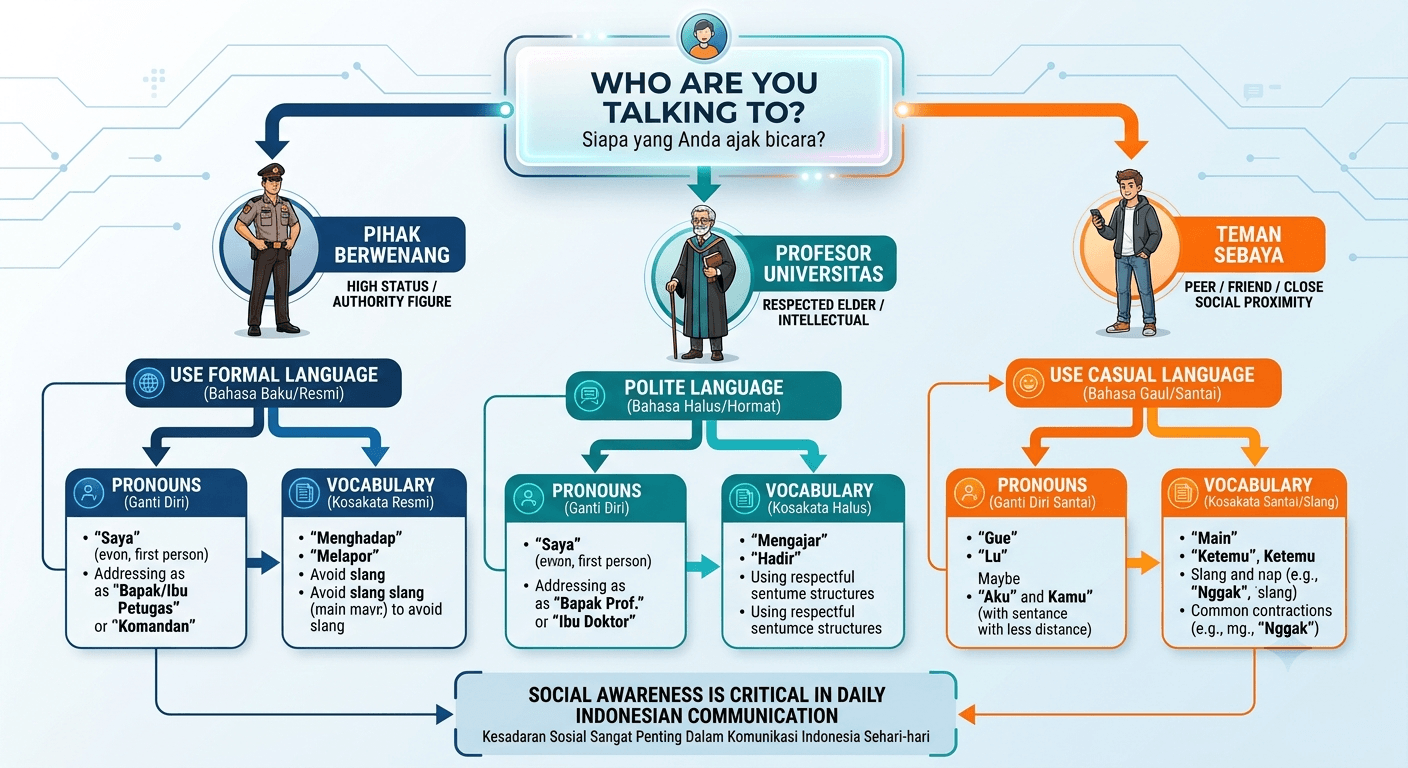
A Comprehensive Strategy for Dual Mastery
Overcoming the massive diglossia barrier requires a completely radical shift in how we fundamentally approach language education. We must immediately abandon the naive illusion that a single traditional textbook can ever provide true fluency. The only viable solution for serious learners is a strictly enforced dual-track immersion strategy.
First, you must absolutely acknowledge that the formal language is structurally necessary. It provides the essential grammatical skeleton of the entire language system. You must deeply understand Bahasa Baku to independently read legal contracts, thoroughly consume national news, and correctly understand the core root structure of words before they are casually abbreviated on the street. Do not violently discard your expensive textbook, but purposefully relegate it to its proper place as a specialized tool for formal comprehension and structural theory.
Second, you must actively and aggressively source informal learning materials. You simply cannot learn authentic street language in a sterile classroom environment. You must purposefully immerse yourself in the actual media that reflects modern everyday life. Watch contemporary Indonesian cinema, particularly modern urban dramas or romantic comedies, and meticulously study the fast-paced dialogue. Listen daily to popular Indonesian podcasts where young hosts chat casually about pop culture. Spend significant time reading the chaotic comment sections on Indonesian social media platforms. This digital landscape is precisely where you will find the real, breathing, living language.
Third, you must actively seek out a native language exchange partner who is exceptionally willing to be brutally honest with you. Most local residents are incredibly polite and will instinctively switch to formal Indonesian when speaking to a foreigner to make things easier for the guest. You must explicitly and clearly ask your language partner to speak to you exactly as they would speak to their very best friend. Demand that they immediately correct you whenever you sound too rigid or robotic.
Diligently build your own personal glossary of slang, abbreviations, and regional terms. Treat the chaotic Bahasa Gaul with the exact same academic rigor and serious dedication that you actively apply to formal Bahasa Baku. Understand that true fluency in Indonesian is not simply about knowing the highest volume of words. It is entirely about knowing the exact right words for the specific social context you find yourself in.
Embracing the Duality of Fluency
The long journey to truly mastering the Indonesian language is a fascinating, mind-provoking exercise in profound cultural adaptation. I find the massive divide between the sterile textbook and the chaotic street to be the absolute most intellectually stimulating aspect of this entire language. It forcefully requires the learner to become a keen, highly observant student of human interaction and social hierarchy.
The popular illusion of Indonesian being a perfectly simple, effortless language shatters incredibly quickly, but what eventually replaces that illusion is far more intellectually rewarding.
You eventually discover a highly dynamic, deeply social language that instantly adapts to every conceivable human situation. The massive structural divide between formal and informal speech is undoubtedly the absolute greatest hurdle for any foreigner attempting to learn the language. However, successfully crossing that wide chasm is the only genuine path to true human connection in the country.
When you can seamlessly and effortlessly transition from quietly reading a highly formal political essay to loudly joking with a local street vendor using their specific regional dialect, you have not just learned a simple language. You have successfully unlocked an entire culture. You must boldly embrace the unpredictable chaos of the street language, deeply respect the historical structure of the formal language, and thoroughly recognize that true, undeniable fluency is the delicate mastery of both.
References:
Errington, J. (1998). Shifting Languages, Interaction and Identity in Javanese Indonesia. Cambridge University Press.
Ewing, M. C. (2005). Grammar and Inference in Conversation: Identifying Clause Structure in Spoken Javanese and Indonesian. John Benjamins Publishing Company.
Mintz, M. W. (2002). Indonesian Grammar in Context Asyik Berbahasa Indonesia. University of Hawaii Press.
Sneddon, J. N. (2003). The Indonesian Language: Its History and Role in Modern Society. University of New South Wales Press.


Are you seeking for an advanced Indonesian course?
Get the Indonesian Affixation Course
For Professional and Institutional Use
© 2026. LEARN INDONESIAN WITH OSSI. ALL RIGHTS RESERVED. Cookie Policy (EU). Legal Notice.