
Understanding Indonesia's Path Forward
If you look at the map and compare Indonesia to powerhouses like Japan, South Korea, or even our neighbors like Singapore, it’s natural to wonder: Why isn't our growth trajectory the same? It is a massive question, and honestly, the answer isn’t just one thing. It is a puzzle of geography, history, and policy.
I’ve been looking into why we face certain hurdles while other nations seem to sprint ahead. Here are the 10 biggest challenges I’ve identified, along with some thoughts on how we might start to clear them.
The 10 Big Challenges
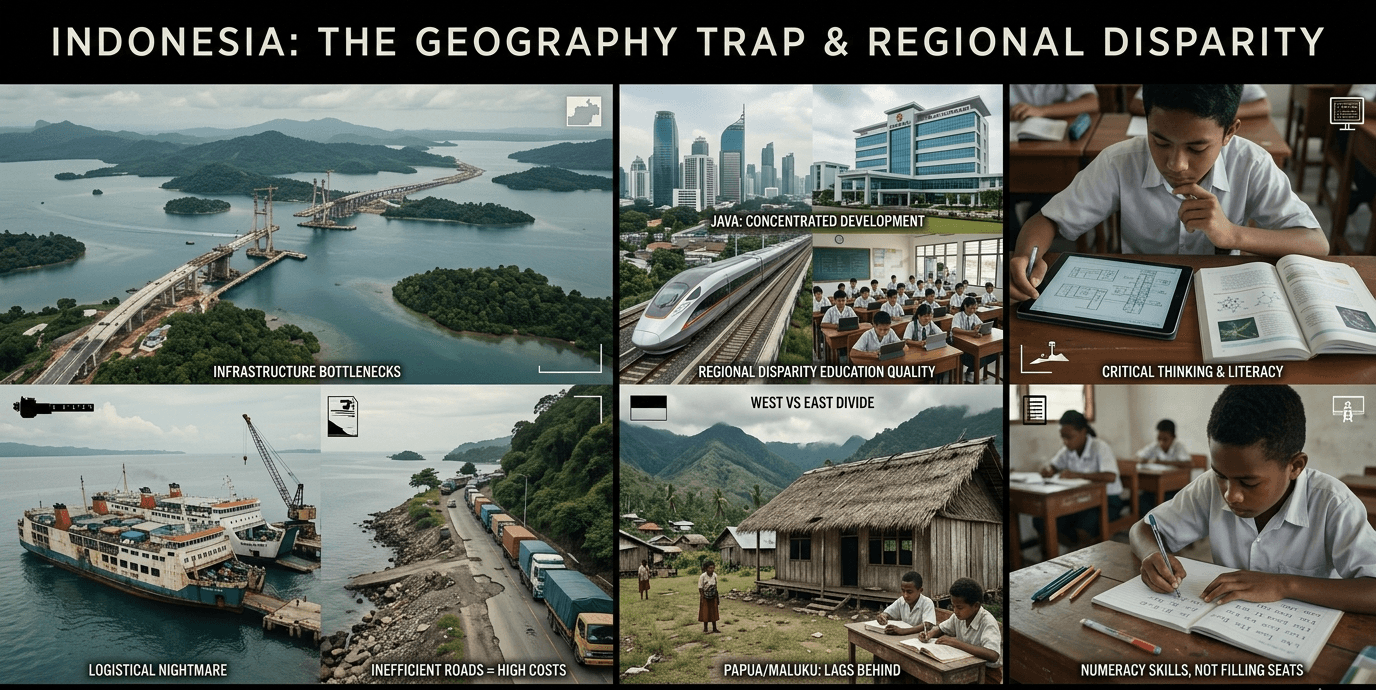
The Geography Trap: Being the world’s largest archipelagic nation is beautiful, but it’s a logistical nightmare.
Connecting thousands of islands makes building roads, ports, and power grids incredibly expensive compared to smaller or land-based countries.
Regional Disparity: We have a major "West vs. East" divide. Development—infrastructure, schools, and hospitals—is heavily concentrated in Java and Sumatra, leaving eastern regions like Papua and Maluku struggling to catch up.
Infrastructure Bottlenecks: Even with recent progress, we still lag behind regional peers. If roads and ports aren’t efficient, the cost of moving goods skyrockets, making our local businesses less competitive.
Education Quality Gap: While many kids are in school, the quality of learning is the real issue. We need to move beyond just filling seats to ensuring students are actually building critical thinking, literacy, and numeracy skills.
Teacher Professionalism: A curriculum is only as good as the person teaching it. Many teachers face challenges with training, resources, and even fair pay, which affects how well they can inspire their students.
Regulatory Uncertainty: Frequent changes in laws or inconsistent enforcement make it really hard for businesses—both local and international—to plan long-term. Investors like stability; they don’t like guessing what the rules will be next year.
Corruption and Transparency: Corruption creates "hidden costs" that slow everything down. It distorts markets and can discourage honest investment, effectively acting as a brake on our economic engine.
Heavy Reliance on Raw Resources: We have traditionally relied on exporting raw materials (mining and agriculture). When global commodity prices drop, our economy feels it immediately. We need to pivot toward higher-value manufacturing and services.
Income Inequality: Economic growth hasn’t trickled down equally. The gap between the wealthy and the poor remains wide, limiting the potential of millions of people who could contribute more to the economy.
The "Middle-Income Trap" Risk: Many developing countries grow to a certain point, then get stuck. To move from a middle-income to a high-income nation, we have to innovate, use better technology, and increase our workforce's productivity, not just rely on cheap labor.
How We Can Improve
It feels overwhelming, but there are clear ways to tackle these issues. It isn't just about government policy; it’s about a collective shift:
Prioritize Foundational Skills: Schools need to focus less on rote memorization and more on "21st-century skills"—critical reasoning, digital literacy, and problem-solving.
Invest in Teacher Empowerment: We have to treat teaching as a top-tier profession. This means better pay, standardized and rigorous training programs, and better resources for schools in remote areas.
Digital Transformation: Technology can help us "leapfrog" some physical infrastructure problems. Expanding broadband access to rural islands allows for online education, telemedicine, and digital banking to reach people who were previously isolated.
Streamline Regulations: The government should focus on "regulatory stability." If businesses know the rules of the game aren't going to change every six months, they are much more likely to invest in factories and jobs.
Diversify the Economy: We need to aggressively move into high-tech manufacturing and the service sector. This means training the workforce in programming, data analysis, and modern engineering, moving away from just exporting raw dirt or palm oil.
Strengthen Anti-Corruption Measures: This is hard, but it starts with transparency. Using e-government systems for public spending and procurement can reduce human-to-human interaction, where bribery often happens.
A Final Thought
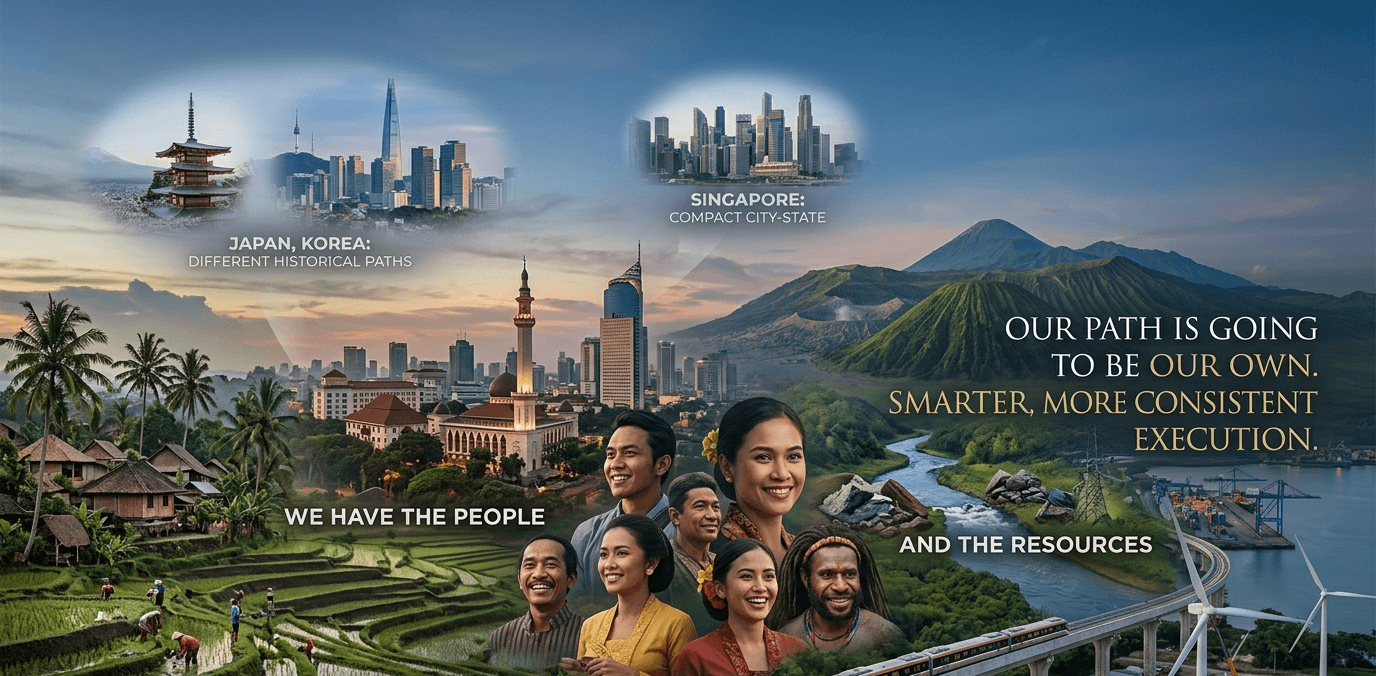
Comparing Indonesia to other countries isn’t about saying one is "better." It’s about realizing that we have our own unique set of circumstances. Japan and Korea had very different historical paths, and Singapore had the advantage of being a compact city-state.
Our path is going to be our own. We have the people and the resources; the next step is just about smarter, more consistent execution.
As you are reading this post, what do you think is the single most important thing we should be doing right now to help the next generation?


Are you seeking for an advanced Indonesian course?
Get the Indonesian Affixation Course
For Professional and Institutional Use
© 2026. LEARN INDONESIAN WITH OSSI. ALL RIGHTS RESERVED. Cookie Policy (EU). Legal Notice.